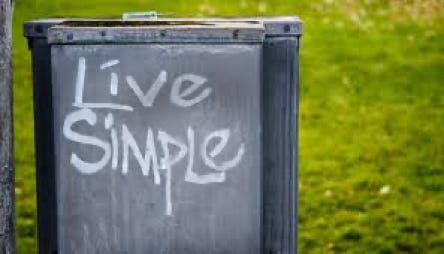
Grateful (?) Simplicity

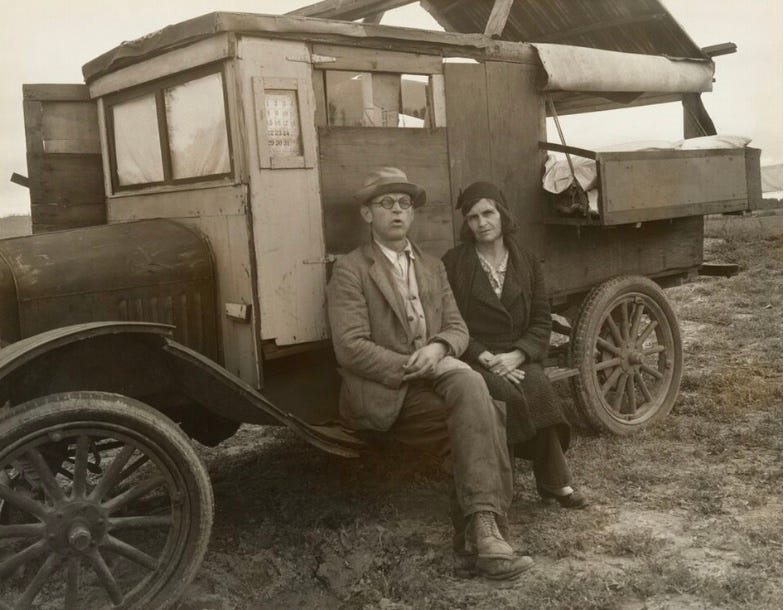
Credit: Dorothea Lange
Grateful simplicity sounds so nice in theory. I can envision myself living with only a few necessary possessions, frequently walking rather than driving, living an uncluttered life while offering prayers of thankfulness.
That’s the theory. The practice on the other hand….. I’m sure I’m not the only one who owns too much stuff (which I’m going to clean out any day now, honest!), who can enter deeply and easily into an attitude of entitlement whenever I can’t quickly or easily get what I think I need.
And, I have to say that Benedict doesn’t seem to be much help in this regard. In his chapter on “Private Ownership” he says: “Above all, the vice of personal ownership in the monastery must be cut out by the very root. Without the superior’s permission, no one may presume to give, receive, or keep anything as one’s own… since monastics are not allowed to have even their bodies or their wills at their own disposal.” RB 33:1-4
My first reaction is to think “Whoa, harsh dude!!” But, as usual, Benedict knew what he was talking about and also knew that being subtle does not work with most of us.
Benedict is trying to make his monks (and us) see that everything we have is a gift. We don’t easily understand or fully appreciate that everything we have and own is ultimately a gift from God. We’re not entitled to anything. Very few of us even grow, make or in any way produce what we own or use. We have to remind ourselves over and over and over again that everything is gift and ultimately a gift from God.
To help his monks understand this basic concept Benedict’s monastery was set up so that the monks would have to ask for what they needed. How quickly would your attitude change if you needed to ask someone for a new blouse or a tool to replace the one you broke? Even if the answer will certainly be “yes,” it will require some humility to go and ask for what you need rather than just going out and getting it yourself.
Benedict is asking his monks to reflect on whether they really need something versus whether they just want it, and then to be grateful to receive something they are simultaneously not entitled to and probably did nothing to earn or produce. Benedict made his monks ask permission as a way to cultivate an attitude of profound gratitude and to clear our soul of the weeds of entitlement that grow so easily and prolifically. The concept is simple but most of us probably belong in the remedial class as we try over and over again to learn it.
So, what’s next? I would like to say that writing this compelled me to immediately minimize my accumulation of “stuff” and to be more grateful for the too much that I already have. I also know that for myself, and most of us, the journey of conversion is long and slow. I will probably try to begin (again!) by pausing the next time I think I “need” something, and to give thanks that I already have all that I need, remembering that everything, even my life, is truly a gift. I will, however, have to keep working on the idea that Benedict might think I don’t really need so many books!