

Those who have eyes to see. . .
Homily for the third Sunday of Easter, 2026 at the Monastery of St. Gertrude

Does anyone else get kind of irritated with the disciples in the Gospel passage? Cleopas and someone else are walking along to Emmaus, and who starts walking along with them, but Jesus. But the disciples think he’s the one who’s a little slow. “Are you the only one who doesn’t know what happened in Jerusalem?” So Jesus starts to do his impression of a communications coach, “really, what sorts of things? Please tell me more.”
Unfortunately, it quickly becomes clear that the two disciples need more than the subtle approach. Personally, I think it took incredible discipline on the part of Jesus not to shake them and say “guys, it’s me, hello!” Understandably Jesus does lose his cool a little bit: “”Oh, how foolish you are! How slow of heart to believe all that the prophets spoke!” He realizes that these disciples are not the sharpest knives in the drawer and so he gives them some special tutoring so that they can understand how the Scriptures foretold the coming of the Messiah. That’s the key, he helps them understand what happened, to get it through their head.
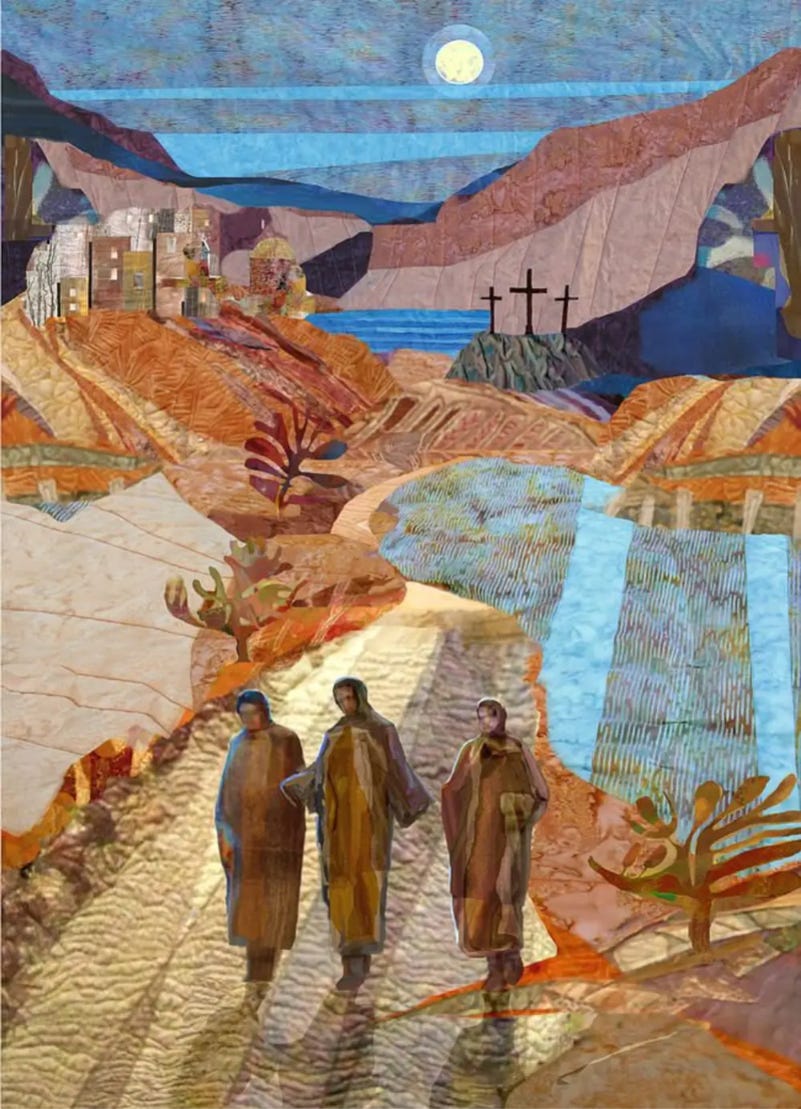
You’d think that would be the end of the story, wouldn’t you? Now they understand the Scriptures, that Jesus’ death and resurrection was foretold, it’s clear. But the story doesn’t end. When they come to their destination it looks like Jesus is going to keep on going, the passage says: “But they urged him, “Stay with us, for it is nearly evening and the day is almost over.” So he went in to stay with them.” It still hasn’t clicked who’ve they’ve been talking to? He’s an interesting guy, he understands the Scriptures, but they don’t know who he is.
He’s stays with them “And it happened that, while he was with them at table, he took bread, said the blessing, broke it, and gave it to them. With that their eyes were opened and they recognized him, but he vanished from their sight.” Up until that moment they didn’t know that Jesus was the Christ. They had an idea that the coming of the messiah was foretold in the Scripture, but they did not experience the risen Christ. It was only in the breaking of the bread that they experienced the lived reality of the resurrection.
The more I reflected I realized this passage isn’t just about the clueless disciples finally recognizing that Jesus is the Christ. The key is the breaking of the bread.
I think this is the important part. They recognize Jesus in an incredibly ordinary way. They didn’t recognize him because he stood in front of the Temple preaching, it wasn’t because he performed a huge miracle, he wasn’t at a Passover seder. He shared a very ordinary meal. He did what they all did at every meal, gave a blessing and shared bread. In an ordinary moment, with an ordinary piece of bread, and an ordinary blessing, that was the moment the disciples realized that reality had changed. The Jesus they saw die is the Christ and death has been defeated.
So this is not only a resurrection story, basically it’s the first Eucharist, isn’t it? For the first time Jesus, the Christ, shares his very presence in bread, wine and blessing. The key is that the presence of the holy is in the ordinary. For the disciples it was ordinary bread, an ordinary blessing. It was a meal like thousands of other meals they’d had but it was different, because the living God is present in ordinary things. The ordinary becomes holy, becomes Eucharist, when the disciples realized that Jesus is the Christ who has defeated power of death. God is alive and we experience the living God in ordinary life.
The story tells us that Jesus is saying—I’m with you in your daily life, when you’re walking down the road, sharing a meal. Jesus is saying—in your journey, in the strangers you meet, in everyday meals, I am present. Daily life is where you encounter me. The reality that I have conquered death means that ultimately the world is holy and daily life is where you see me.
Perhaps this passage is telling us that the Eucharist, when ordinary bread and wine become the presence of Christ, doesn’t just happen on special occasions. Maybe this story means that we live in a Eucharistic world. The risen Christ is present everywhere, in all that we experience. Like the slightly clueless disciples, we only need to open our eyes and recognize the risen Christ in our midst. Here, today, He is risen. Christ has conquered death and invites to experience a eucharistic world in which we experience his presence on our journey, in our conversations, in everyday meals.
To be clear, we are extremely blessed to be celebrating Mass this morning, what a gift, but I’d invite to you to also be blessed throughout the day by realizing we live in a eucharistic world where Christ is present in all our ordinary moments.
He is risen, alleluia!